The Art of Deep Reading: How to Extract Ten Arguments from a Single Academic Source

Photo: various, Public domain, via Wikimedia Commons
The Reference Count Fallacy
Walk into any university library during assessment season and you will observe a familiar ritual: students scrolling through search results, opening PDFs, skimming abstracts, and adding sources to their reference lists with the urgency of collectors. The implicit logic is understandable — more sources suggest more research, and more research suggests more effort and authority.
The problem is that this logic is largely wrong, and experienced markers know it immediately.
An essay that cites thirty sources but engages with none of them substantively is, academically speaking, weaker than an essay that cites eight sources and demonstrates genuine analytical command of each. The former signals breadth without depth; the latter signals the kind of critical engagement that distinguishes a 2:1 from a First. This article is concerned with developing the second approach — specifically, with the skill of extracting maximum analytical value from a single academic text.
Why Deep Reading Produces Better Arguments
When you engage superficially with a source — reading the abstract, skimming the conclusion, lifting one quotation — you acquire only the author's headline claim. You miss the methodology, the qualifications, the evidence base, the theoretical framework, the sources the author themselves cites, and the counter-positions the author addresses or dismisses.
Each of these elements is a potential argument in your essay. Deep reading does not merely give you more to say about a source; it gives you more intellectually precise things to say, drawn from a genuine encounter with the text rather than a cursory pass.
This matters because markers are reading for the quality of your engagement, not the volume of your bibliography. A sentence that reads Smith (2019) argues that neoliberal housing policy has exacerbated urban inequality is adequate. A sentence that reads Smith (2019), drawing on longitudinal rental data from six English cities, argues that neoliberal housing policy has structurally reproduced urban inequality — a claim that sits in productive tension with Jones (2021)'s contention that local authority discretion mitigates systemic effects demonstrates that you have read Smith carefully enough to understand both the evidential basis and the disciplinary conversation surrounding the argument.
A Framework for Multi-Layered Source Engagement
The following framework offers a systematic approach to extracting multiple analytical layers from a single text. Apply it to one source before your next essay submission and observe how it transforms the density of your analysis.
Layer One: The Central Claim
What is the author's primary argument? Summarise it in one sentence without using any of the author's own language. This forces genuine comprehension rather than paraphrase. If you cannot do this, you have not yet understood the source.
Layer Two: The Evidential Foundation
What evidence does the author use to support their claim? Is it empirical, theoretical, historical, or textual? Is the evidence discipline-appropriate? Are there gaps or limitations in the data set? Identifying the evidential base allows you to assess the argument's robustness rather than simply accepting it — which is precisely what critical engagement means.
Layer Three: The Theoretical Framework
Most academic sources operate within an implicit or explicit theoretical tradition. Is the author writing from a Marxist, feminist, postcolonial, empiricist, or constructivist perspective? Understanding the theoretical orientation of a source allows you to position it within broader disciplinary debates and to identify the assumptions that underpin its conclusions.
Layer Four: The Qualifications and Caveats
Academic authors almost always qualify their arguments. They acknowledge limitations, scope conditions, and exceptions. These qualifications are frequently the most analytically productive parts of a text — and students almost universally ignore them. A caveat in your source is an invitation to extend, challenge, or nuance the argument in your own essay.
Layer Five: The Counter-Positions Addressed
What opposing arguments does the author acknowledge or refute? These counter-positions are effectively pre-packaged for your use. If Smith engages with Jones's critique and you have read Smith carefully, you have access to both positions without necessarily reading Jones in full — though reading Jones directly is always preferable where time permits.
Layer Six: The Methodological Implications
How the author arrived at their conclusion is as important as the conclusion itself. Different methodological choices produce different kinds of knowledge claims. A qualitative case study and a large-scale quantitative survey may reach similar conclusions through entirely different routes — and those routes carry different implications for generalisation, replicability, and disciplinary validity.
Layer Seven: The Disciplinary Conversation
Where does this source sit in the literature? Is it a foundational text, a recent intervention, a minority position, or a synthesis of existing debates? Understanding a source's disciplinary position allows you to contextualise it accurately rather than treating it as a free-floating authority.
Annotating for Argument, Not Summary
The practical mechanism for deep reading is annotation — but annotation conducted with analytical purpose rather than as a highlighting exercise. When you annotate, write in the margins (or in a parallel document) not what the author says but what it means for your argument.
For example, rather than noting Smith argues neoliberalism causes inequality, annotate this challenges my paragraph 3 claim — need to address this directly or useful counter to Jones — use in my rebuttal section or methodology limited to English cities — does not account for Welsh housing policy context.
This approach transforms annotation from passive recording into active argumentation, and it ensures that when you return to the source during drafting, every marked passage is already connected to a specific function in your essay.
A Practical Example
Suppose you are writing a law essay on the Human Rights Act 1998 and its relationship to parliamentary sovereignty. You locate one well-regarded journal article — say, a piece by a constitutional law scholar examining the Ghaidan v Godin-Mendoza [2004] judgment.
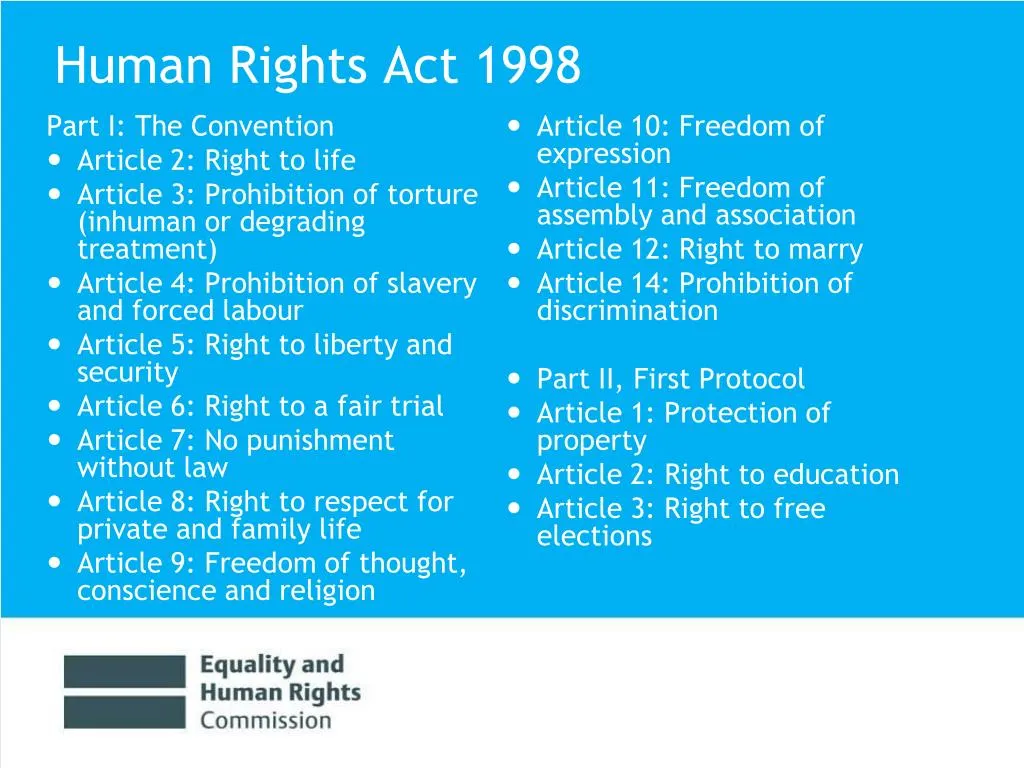 Photo: Human Rights Act 1998, via image1.slideserve.com
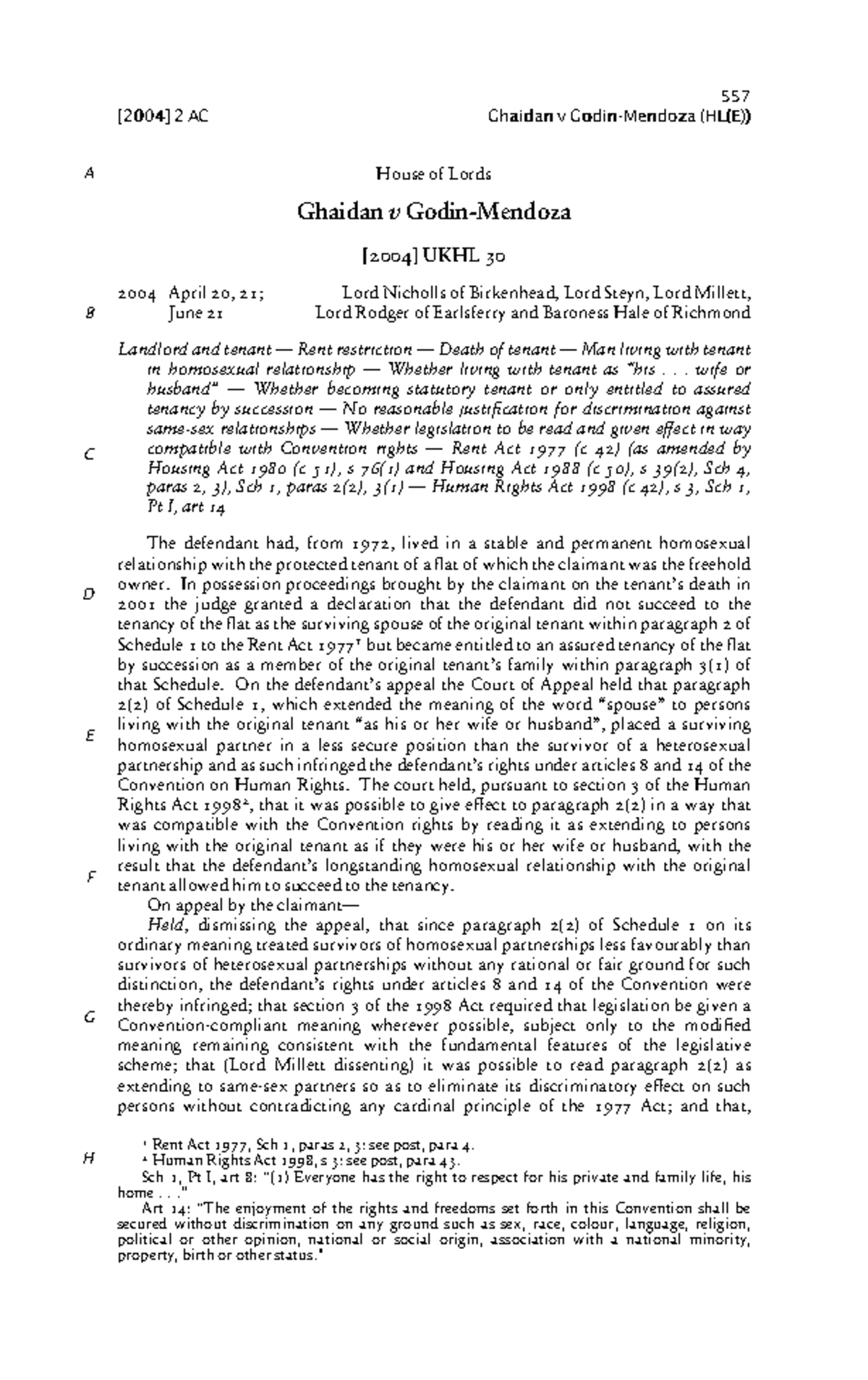 Photo: Ghaidan v Godin-Mendoza, via website-assets.studocu.com
Deep reading of that single article might yield: the author's central interpretive claim about section 3 HRA; their evidential use of Lords' speeches from the case; their implicit legal positivist framework; their caveat that the decision may not apply consistently to criminal law contexts; their engagement with Lord Millett's dissent; their methodological reliance on doctrinal analysis rather than empirical study of judicial behaviour; and their positioning of the case within the broader debate between parliamentary and judicial supremacy.
That is seven distinct analytical angles from one source — each of which could anchor a paragraph, generate a counter-argument, or sharpen a qualification in your essay.
Quality Over Accumulation
The shift from surface-level breadth to analytical depth is one of the most significant intellectual transitions available to UK undergraduates. It is also, paradoxically, less time-consuming than it appears — because deep engagement with six carefully chosen sources takes no longer than superficial engagement with twenty, and produces substantially better writing.
At EssayWise UK, we consistently observe that the essays which secure the highest marks are not those with the longest bibliographies. They are the ones where every cited source is visibly understood, critically positioned, and purposefully deployed. That standard is achievable — and it begins with reading one text properly.