
The seminar room buzzes with animated debate about postcolonial literature, economic theory, or historical interpretation. Ideas flow freely, arguments develop organically, and sudden insights illuminate complex concepts. Yet when essay deadlines approach, many UK students treat these rich discussions as entirely separate from their written work, essentially discarding hours of valuable intellectual development.
This disconnect represents one of the most significant missed opportunities in UK higher education. Seminars aren't merely supplementary to your essays—they're laboratories for developing, testing, and refining the very arguments that will distinguish your written work from the crowd.
The Hidden Connection Between Spoken and Written Academic Discourse
University seminars serve multiple pedagogical functions beyond simple information transfer. They provide safe spaces for intellectual risk-taking, opportunities to hear diverse perspectives, and platforms for testing preliminary ideas before committing them to paper. Most importantly, they reveal how academic arguments develop through dialogue rather than isolation.
When you participate in seminar discussions, you're engaging in the same intellectual processes required for essay writing:
- Synthesising multiple sources of information
- Responding to counterarguments in real time
- Building upon others' ideas whilst maintaining your own perspective
- Articulating complex thoughts under time pressure
The key difference lies in format rather than substance. Essays simply require you to conduct these conversations on paper, drawing upon the insights and techniques you've already practised verbally.
Strategic Note-Taking for Essay Development
Transforming seminar discussions into essay material requires systematic documentation that goes beyond passive transcription. Effective seminar notes should capture both content and process—not just what was said, but how arguments developed and why certain points proved persuasive.
The Three-Column Method
Divide your note-taking page into three distinct sections:
Column 1: Core Arguments: Record the main points raised during discussion, including who presented them and any supporting evidence mentioned.
Column 2: Development Process: Note how arguments evolved through dialogue. Did someone's perspective shift? Were initial claims refined or abandoned? How did the group build upon individual contributions?
Column 3: Essay Potential: Identify ideas with particular relevance to upcoming assignments. Mark potential thesis statements, useful examples, or counterarguments worth exploring further.
This method transforms passive listening into active intellectual engagement whilst creating a valuable resource for future writing.
Capturing Argumentative Dynamics
Pay particular attention to moments when:
- Someone successfully challenges a widely accepted viewpoint
- Multiple perspectives converge on unexpected common ground
- Initial disagreement leads to more nuanced understanding
- A seemingly simple question reveals underlying complexity
These dynamics often indicate rich territory for essay exploration, providing natural structures for written arguments.
Mining Tutor Commentary for Academic Insights
Your seminar tutors aren't merely facilitating discussion—they're demonstrating advanced academic thinking in action. Their interventions, questions, and observations provide masterclasses in scholarly analysis that can significantly enhance your essay writing.
Decoding Tutor Questions
When tutors pose questions during seminars, they're rarely seeking simple factual answers. Instead, they're highlighting analytical opportunities or pointing toward more sophisticated ways of approaching topics.
If your tutor asks, "But what assumptions underlie that argument?", they're demonstrating critical thinking techniques you should apply in your essays. When they query, "How might this evidence be interpreted differently?", they're showing you how to engage with source material analytically rather than descriptively.
Document these questions alongside their contexts. They often reveal the kind of analytical depth your tutors expect in written work.
Identifying Scholarly Frameworks
Tutors frequently reference theoretical frameworks, methodological approaches, or interpretive lenses during discussions. These references provide valuable scaffolding for your essays, offering established ways to structure complex arguments.
When a history tutor mentions "considering this through a social history lens" or an English tutor suggests "applying poststructural analysis", they're providing roadmaps for essay organisation and analytical approaches.
Leveraging Peer Perspectives for Argumentative Depth
Your fellow students represent diverse backgrounds, experiences, and ways of thinking that can enrich your essay arguments significantly. Rather than viewing peers as competition, approach them as collaborators in intellectual development.
Identifying Strong Student Arguments
Pay attention to moments when classmates present particularly compelling points. What makes their arguments effective? How do they structure their reasoning? What evidence do they draw upon?
Analyse successful peer contributions using the same critical tools you'd apply to published scholarship. This practice develops your ability to recognise strong argumentation whilst providing models for your own writing.
Constructive Disagreement as Essay Fuel
Seminar debates often reveal the complexity inherent in academic topics. When classmates disagree about interpretation or emphasis, they're demonstrating the contested nature of knowledge that makes essays intellectually engaging.
Document these disagreements carefully. They provide natural starting points for essays that acknowledge multiple perspectives whilst developing your own reasoned position.
From Discussion to Draft: Practical Transformation Strategies
The Seminar Summary Exercise
Within 24 hours of each seminar, write a 300-word summary addressing:
- The session's central debate or theme
- Three key insights that emerged through discussion
- Two questions that remain unresolved or controversial
- One connection to your upcoming essay topics
This exercise consolidates learning whilst identifying potential essay material before details fade from memory.
Argument Mapping Technique
Select the most engaging debate from your seminar and create a visual map showing:
- Initial positions presented by different participants
- Evidence or reasoning offered in support
- Challenges or counterarguments raised
- How positions evolved through dialogue
- Points of consensus or continued disagreement
This mapping process reveals argument structures you can adapt for essay writing whilst highlighting areas requiring further research.
The Devil's Advocate Approach
Choose a position you supported during seminar discussion and spend 20 minutes arguing against it in writing. This exercise:
- Reveals potential weaknesses in your reasoning
- Develops counterarguments you'll need to address in essays
- Demonstrates intellectual flexibility valued in academic writing
- Generates content for more nuanced, sophisticated arguments
Integrating Seminar Insights into Essay Structure
Opening with Observed Complexity
Use seminar discussions to craft engaging essay introductions that acknowledge genuine intellectual complexity rather than presenting topics as straightforward or uncontested.
Instead of: "This essay will examine the causes of the English Civil War."
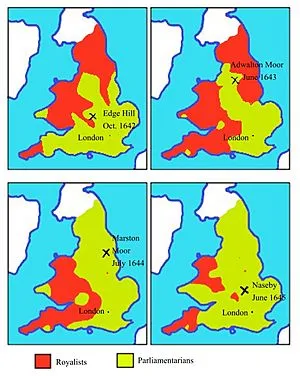 Photo: English Civil War, via kids.kiddle.co
Consider: "Recent seminar discussions have revealed significant disagreement among historians regarding the relative importance of religious, political, and economic factors in precipitating the English Civil War, suggesting that..."
Building Arguments Through Dialogue
Structure essay paragraphs to mirror effective seminar exchanges:
- Present an initial claim or interpretation
- Acknowledge potential objections or alternative viewpoints
- Provide evidence that addresses these challenges
- Refine your position based on this engagement
This approach demonstrates the sophisticated thinking that emerges through intellectual dialogue.
Conclusion as Continued Conversation
Rather than treating conclusions as final statements, frame them as contributions to ongoing academic conversations—much like seminar discussions that continue beyond scheduled sessions.
Acknowledge questions your essay hasn't fully resolved and suggest directions for future investigation. This approach positions you as an active participant in scholarly discourse rather than a passive recipient of established knowledge.
Maximising Future Seminar Participation
Once you recognise seminars as essay preparation opportunities, your participation becomes more strategic and productive:
- Come prepared with specific questions about upcoming essay topics
- Test preliminary thesis statements through discussion
- Seek feedback on potential arguments or interpretations
- Use seminar time to explore ideas you're considering for written work
This approach transforms seminars from passive learning experiences into active writing workshops, ensuring that classroom discussions directly enhance your essay quality and academic performance.
Remember that the best academic essays don't emerge in isolation—they develop through engagement with ideas, evidence, and alternative perspectives. Your seminar discussions provide all three in abundance. By systematically harvesting these resources, you'll discover that the path from classroom conversation to essay excellence is shorter than you imagined.